

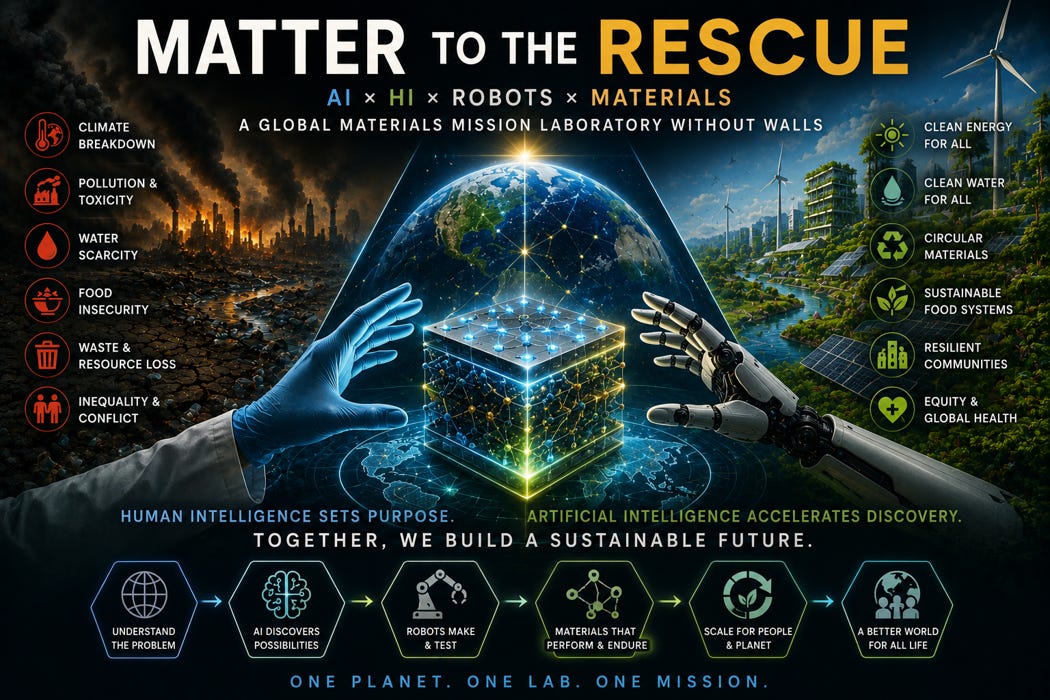
VISUAL ESSAY - MATTER TO THE RESCUE. A damaged material world faces the sustainable world we could still build. Between them, human purpose and artificial intelligence converge on advanced functional matter: the physical bridge from discovery to clean energy, clean water, circular resources and resilient communities.
Humanity created many of the material problems now threatening the conditions in which civilization can flourish. What if human intelligence, artificial intelligence, robotics and materials science were mobilized together not to compete for the future, but to repair it?
The Trouble with Being Clever
Humanity has become extraordinarily good at changing matter and remarkably poor at living with all the consequences. We burned ancient carbon to power civilization, manufactured materials that persist long after their usefulness, depleted resources faster than nature can replenish them, contaminated water and soil, and built a material economy whose benefits and burdens are distributed profoundly unevenly. These were not simply failures of intelligence. In many cases, they were triumphs of it.
The problem is that our power grew faster than our wisdom.
Now another intelligence has entered the story. Artificial intelligence can search chemical and structural spaces no human could traverse, connect enormous scientific literatures, predict properties, learn from failed experiments and propose materials we might never have imagined [1]. Robotics can give that intelligence hands, turning prediction into synthesis, measurement and repeated experimentation [2]. Human intelligence contributes something different and indispensable: imagination, experience, intuition, purpose, ethics and the ability to decide what is actually worth doing.
AI × HI × ROBOTS × MATERIALS
Not replacement. Multiplication.
Four Problems. Four Materials Missions.
Consider climate and energy: better photovoltaic and solid-state energy materials, catalysts for hydrogen and solar fuels, batteries and thermal storage, carbon-capture sorbents and low-carbon industrial processes. Consider water and food: selective membranes, sorbents, catalysts, fertilizers, sensors and water-management materials that can make purification and agriculture less energy- and resource-intensive [3]. Consider waste and resource depletion: recyclable-by-design polymers, selective separations and technologies that recover critical elements rather than consigning them to landfill [4]. And consider the human habitat: low-carbon cement and steel, passive-cooling materials, smart windows, thermal storage, durable coatings and adaptive structures.
The point is not that one miraculous material will save us.
It is that civilization now requires millions of better materials decisions made faster, tested more rigorously and judged more wisely. AI can widen the field of possibility; human scientists and engineers can constrain it by abundance, toxicity, manufacturability, cost, durability, circularity and social purpose. Recent work on AI-enabled sustainable materials makes precisely this broader connection between performance, life-cycle thinking and circularity [5].
The Global Materials Mission Laboratory Without Walls
So why not create one? Not another building, another national initiative or another scientific competition, but a Global Materials Mission Laboratory Without Walls: universities, companies, national laboratories, autonomous laboratories, AI systems, robots, engineers and materials scientists around the world connected to a small number of shared planetary missions.
A material imagined in Toronto could be computationally challenged elsewhere, synthesized robotically in another laboratory, characterized across several continents, tested under realistic conditions, subjected to life-cycle and economic analysis, and redesigned by AI learning from every result. The emerging self-driving-laboratory field already points toward networked scientific infrastructure in which AI, robotics, interoperable experiments and complete data provenance can accelerate discovery [2]. What is missing is not the technological direction. It is the planetary mission.
ONE PLANET. ONE LAB. ONE MISSION.
The analogy is deliberately provocative: a Manhattan Project turned inside out. The twentieth-century project demonstrated what could happen when exceptional scientific talent, engineering, infrastructure and urgency were concentrated on one objective.
The twenty-first century needs comparable intensity directed not toward destruction, but toward repair openly, internationally and with stewardship built into the mission from the beginning.
Intelligence Is Not Enough
There is one essential safeguard. We cannot optimize performance alone. Every proposed material must also confront abundance, toxicity, energy and water use, scalability, lifetime, recoverability, affordability and access. Otherwise AI could merely help humanity make unsustainable things more efficiently. Safety and responsible governance must therefore grow alongside autonomous discovery [6].
AI can help us discover what matter can do.
Human intelligence must help decide what matter should do.
Matter to the Rescue
The planet itself does not need rescuing. Earth has survived for billions of years and will continue long after us. What is vulnerable is the extraordinary envelope of climate, water, soil, biodiversity and social stability within which human civilization and countless other forms of life can flourish.
Perhaps, then, we have been asking the wrong question about artificial intelligence. Instead of endlessly asking whether AI will replace us, control us or destroy us, we might ask whether two forms of intelligence can learn to work together well enough to repair some of the damage created by one of them.
Humans created the problems. Humans alone have struggled to solve them. Now we have a new partner. The decisive invention may not be a catalyst, membrane, battery, polymer, energy material or robot at all. It may be the partnership that learns how to create all of them wisely.
MISSION IMPOSSIBLE - A PLANETARY PARTNERSHIP MATTER TO THE RESCUE
AI × HI × ROBOTS × MATERIALS
A better planet for all life.
Materials Food for Thought
Perhaps the greatest materials discovery of the twenty-first century will not be a material at all. It will be a new way of discovering together.
Question of the Day
If humanity could mobilize one Global Materials Mission Laboratory Without Walls, which planetary materials problem should it attack first?
References
1. Mouyang Cheng, Chu-Liang Fu, Ryotaro Okabe, Abhijatmedhi Chotrattanapituk, Artittaya Boonkird, Nguyen Tuan Hung and Mingda Li, “Artificial intelligence-driven approaches for materials design and discovery,” Nature Materials 25, 174–190 (2026). DOI: 10.1038/s41563-025-02403-7.
2. Richard B. Canty and Milad Abolhasani, “The past, present and future of self-driving laboratories,” Nature Reviews Chemistry (2026). DOI: 10.1038/s41570-026-00847-2.
3. Jay R. Werber, Chinedum O. Osuji and Menachem Elimelech, “Materials for next-generation desalination and water purification membranes,” Nature Reviews Materials 1, 16018 (2016). DOI: 10.1038/natrevmats.2016.18.
4. Geoffrey W. Coates and Yutan D. Y. L. Getzler, “Chemical recycling to monomer for an ideal, circular polymer economy,” Nature Reviews Materials 5, 501–516 (2020). DOI: 10.1038/s41578-020-0190-4.
5. Ning Han, Heng Guo, Bingqi Zhang, Zeai Huang, Ying Zhou, Anke Weidenkaff and Guoxing Chen, “Artificial intelligence as a driver of sustainable materials and circularity,” Nature Reviews Materials 11, 510–512 (2026). DOI: 10.1038/s41578-026-00912-8.
6. Shi Xuan Leong, Caleb E. Griesbach, Rui Zhang, Kourosh Darvish, Yuchi Zhao, Abhijoy Mandal, Yunheng Zou, Han Hao, Varinia Bernales and Alán Aspuru-Guzik, “Steering towards safe self-driving laboratories,” Nature Reviews Chemistry 9, 707–722 (2025). DOI: 10.1038/s41570-025-00747-x.